
Introduction
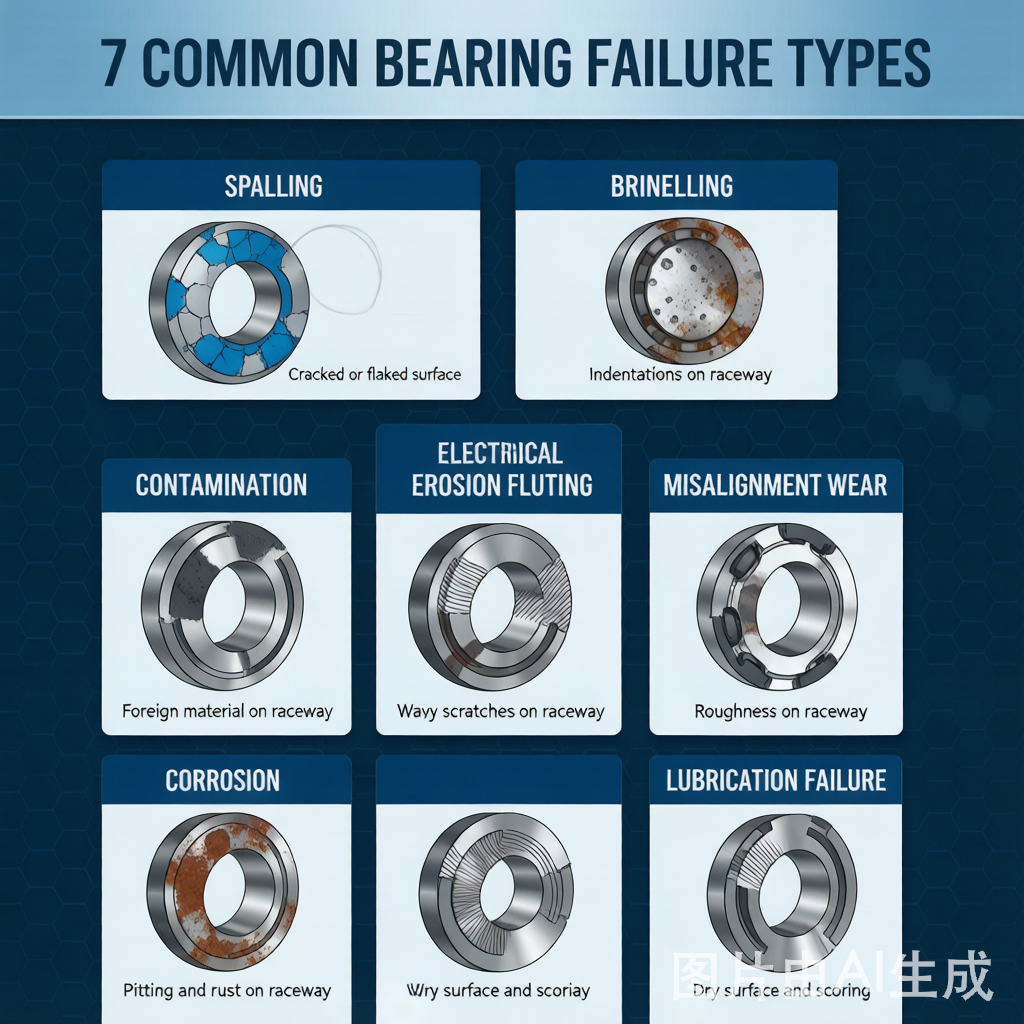
Bearing failures rarely happen in isolation. When a bearing fails prematurely — defined as failure before reaching its calculated L10 fatigue life — there’s almost always a root cause in installation, lubrication, contamination, or operating conditions. Misdiagnosing the failure mode leads to repeated failures and escalating costs. This guide covers the seven most common bearing failure causes, how to identify each one from visual inspection, and the corrective actions that prevent recurrence.
Failure #1: Improper Installation — False Brinelling and Denting
Poor installation technique is the leading cause of premature bearing failure — accounting for roughly 16-27% of all failures in industrial surveys. The most common installation errors include:
- Hammering the bearing onto the shaft — this creates small dents (true brinelling) in the raceway at ball-spacing intervals. Use an induction heater or hydraulic press instead.
- Misaligned press-fitting — cocking the bearing during mounting causes uneven axial force and damages the cage. Always use proper mounting sleeves.
- Incorrect interference fit — a fit that’s too tight causes excessive preload and overheating; too loose allows inner ring creep on the shaft. Follow manufacturer fit tables (typically j5 to m6 for shafts, H7 to JS7 for housings).
- False brinelling — vibration during storage or transport without rotation polishes elliptical depressions into the raceway at ball spacing. Rotate stored equipment periodically, and use anti-fretting grease for transported machinery.
Failure #2: Lubrication Failure — The 36% Problem
Industry data shows that lubrication-related problems cause roughly 36% of all premature bearing failures. The failure chain usually follows one of these paths:
- Grease hardening — base oil separates from the thickener at high temperature, leaving a waxy residue that blocks lubricant flow. Use grease with adequate dropping point (at least 30°C above operating temperature).
- Oil oxidation — oxygen + heat forms sludge and varnish deposits on raceways. Change oil at intervals based on operating temperature (every 15°C above 70°C halves oil life).
- Inadequate relubrication interval — the bearing runs dry if re-greasing intervals are too long. Calculate intervals using the formula: t = K × [(14×10⁶)/(n×d⁰·⁵) – 4d], where n is speed in RPM, d is bore in mm, and K is a grease-specific factor.
- Grease incompatibility — mixing lithium and sodium-complex greases can cause the thickener structure to collapse. Always purge old grease completely when switching types.
Failure #3: Contamination — Particles, Water, and Chemicals
Particle contamination is responsible for about 14% of bearing failures. A single hard particle (silica, metal chip, weld spatter) rolling through the contact zone creates a surface indentation. Under repeated stress, cracks propagate from the dent and eventually cause spalling. Key contamination sources:
- Ingress through worn seals — replace seals at bearing replacement intervals
- Dirty lubricant — use filtered grease guns (3-micron filtration recommended)
- Water contamination — as little as 500 ppm water in oil can reduce bearing life by 75%. Water causes hydrogen embrittlement and corrosion pitting.
- Built-in contamination — casting sand, machining chips from the housing. Always clean housing bores thoroughly before mounting.
Failure #4: Electrical Erosion — VFD-Induced Bearing Currents
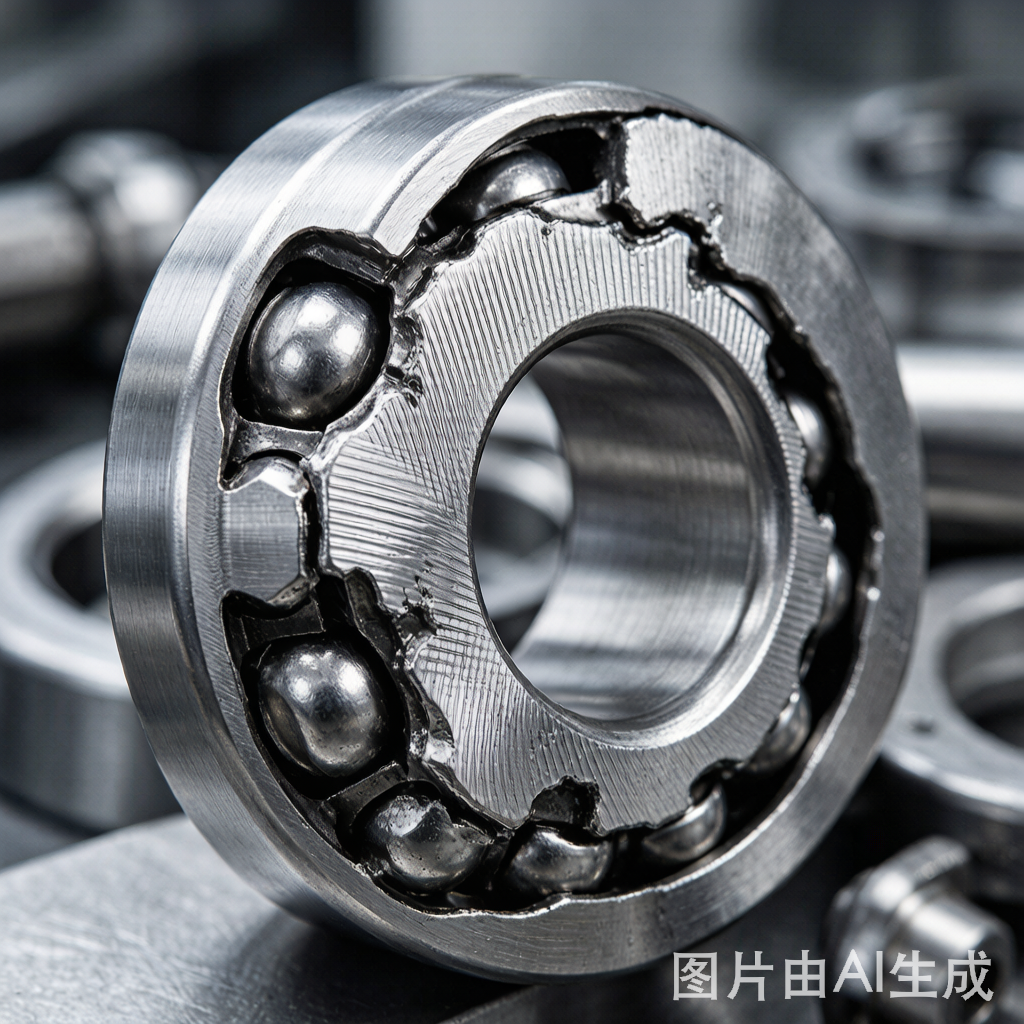
Variable frequency drives (VFDs) create common-mode voltage that discharges through the bearing as shaft currents. The result is fluting — a washboard-like pattern on the raceway — or pitting from individual arc strikes. Solutions include:
- Insulated bearings with ceramic-coated outer rings (or hybrid bearings with ceramic balls)
- Shaft grounding rings (AEGIS type) to divert current around the bearing
- Common-mode chokes on the VFD output
- Conductive grease (though this is a partial solution at best)
Failure #5: Fatigue Spalling — Normal End-of-Life vs Premature
Fatigue spalling is the only failure mode that can be considered “normal.” It appears as spalls (flaking material) on the raceway surface, originating from subsurface shear stresses. But the key question is when it occurs:
- Normal fatigue — spalling begins after the bearing has exceeded its calculated L10 life (the point at which 10% of a batch would show fatigue). This is expected and acceptable.
- Premature fatigue — spalling before L10 life indicates overload, inadequate internal clearance (thermal expansion causing excessive preload), or poor-quality steel with non-metallic inclusions.
Failure #6: Misalignment and Skewed Loads
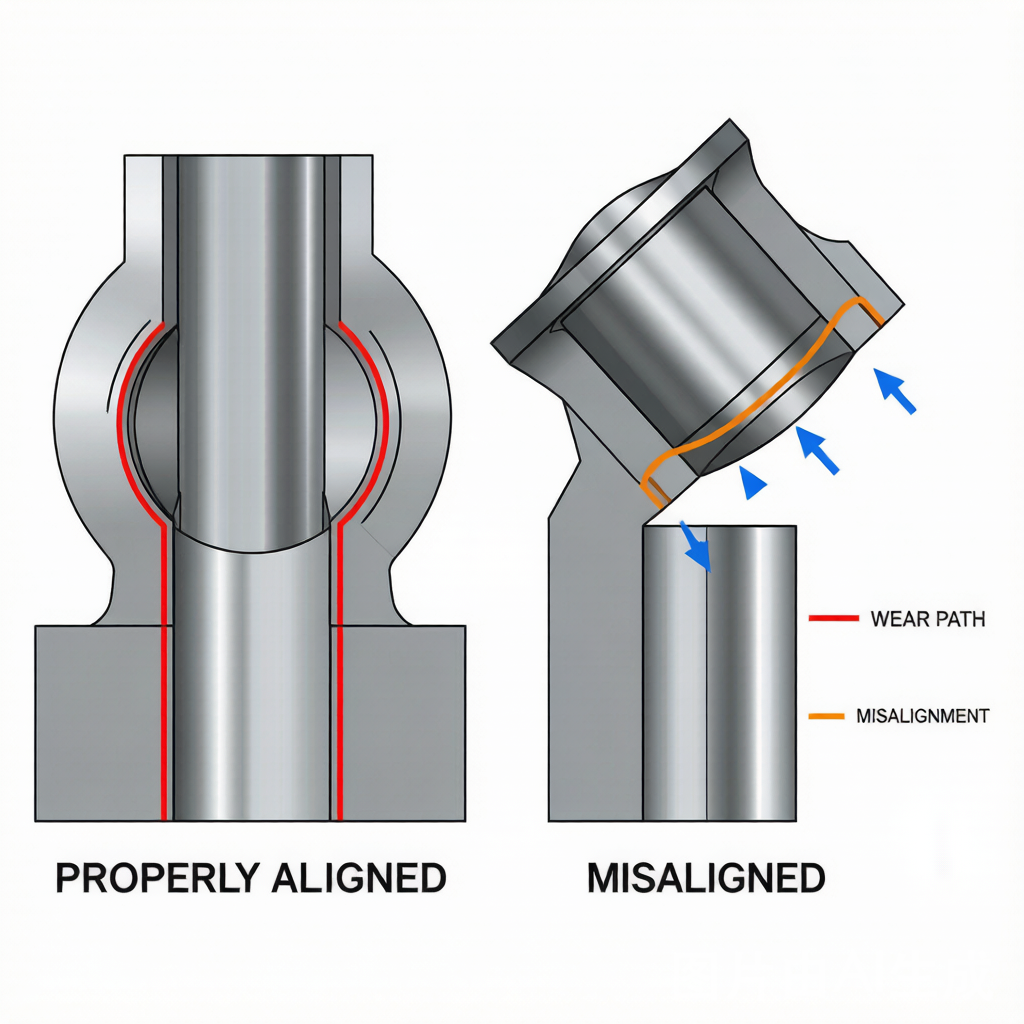
Misalignment between the shaft and housing bore forces the rolling elements to travel along a skewed path, increasing stress at the edge of the raceway. Symptoms include:
- Wear path running diagonally across the raceway (not parallel to the raceway edge)
- Excessive cage wear on one side
- High vibration at 2× rotational frequency
Self-aligning ball bearings or spherical roller bearings can accommodate 1-3° of misalignment. For rigid bearings (deep groove, cylindrical roller), keep shaft/housing misalignment below 0.001 radians.
Failure #7: Corrosion — Storage, Condensation, Chemical Attack
Corrosion is especially common in food processing, marine, and chemical plant environments. Even fingerprint acid from handling a bearing without gloves can initiate corrosion spots that grow into spalls. Prevention:
- Store bearings in original packaging with desiccant until ready to install
- Handle only with clean gloves
- Use stainless steel bearings (440C or AISI 316) in wet environments
- Specify sealed/shielded bearings with water-resistant grease (calcium sulfonate complex) for washdown areas
Conclusion
Accurate failure diagnosis is the first step to eliminating recurring bearing problems. Photograph the failed bearing before disassembly, note the operating conditions at time of failure, and always retain the failed bearing for post-mortem analysis. For complex failure investigations, Boret’s engineering team offers free failure analysis support — send us photos of the failed bearing and raceway, and we’ll help identify the root cause and recommend corrective actions.