
Why Bearing Selection Matters
Choosing the wrong bearing is one of the most costly mistakes in mechanical design. A bearing that is undersized, uses the wrong material, or has insufficient precision grade will lead to premature failure, unplanned downtime, and expensive replacements. At Boret Bearings, we have seen too many procurement teams order bearings based solely on dimensions — only to discover the hard way that bearing selection is about far more than inner diameter and outer diameter.
This guide walks you through the complete bearing selection process, from understanding load types to verifying material compatibility and precision grades. Whether you are a maintenance engineer replacing a failed bearing or a design engineer specifying components for new equipment, this framework will help you make the right call every time.
Step 1: Define Your Load Type and Direction
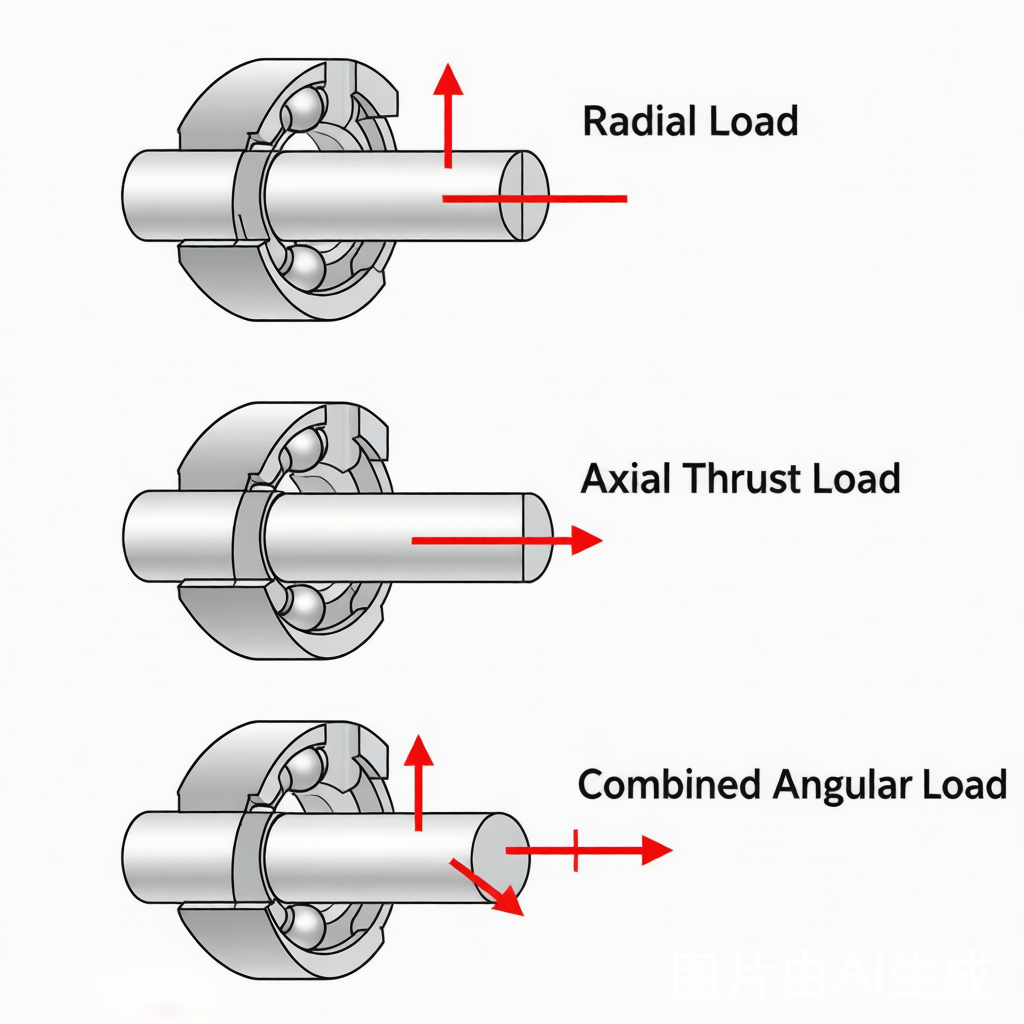
The first and most critical step is understanding what kind of load your bearing will carry. Bearings are optimized for specific load directions, and mismatching can reduce lifespan by 80% or more.
Radial Load
Radial loads act perpendicular to the shaft. This is the most common load type in rotating equipment — electric motors, pumps, gearboxes, and conveyor rollers all primarily see radial loads. If your application involves a rotating shaft supporting weight, you are dealing with radial load.
Best bearing types for pure radial loads:
- Deep groove ball bearings (most common, handles radial + light axial)
- Cylindrical roller bearings (highest radial capacity for heavy loads)
- Needle roller bearings (compact design, high radial in small space)
Axial Load (Thrust)
Axial loads act parallel to the shaft. Think of a vertical pump motor where the weight pushes down the shaft, or a screw compressor where thrust is generated during operation. If the force runs along the axis of rotation, you need a bearing designed for thrust.
Best bearing types for axial loads:
- Thrust ball bearings (pure axial, low-to-medium speed)
- Angular contact ball bearings (combined radial + axial)
- Tapered roller bearings (heavy radial + heavy axial, ideal for automotive)
Combined Load
In reality, most applications have combined loads — a mix of radial and axial forces. Gearboxes, wheel hubs, and machine tool spindles all produce combined loading. The ratio of radial to axial force determines which bearing type is optimal.
Best bearing types for combined loads:
- Angular contact ball bearings (contact angle 15, 25, or 40 degrees for different ratios)
- Tapered roller bearings (handles the heaviest combined loads)
- Spherical roller thrust bearings (misalignment + combined load)
Step 2: Determine Speed Requirements
Bearing speed capability is defined by the limiting speed and reference speed published in manufacturer catalogs. These values depend on bearing type, lubrication method, cage material, and precision grade.
| Bearing Type | Speed Capability | Typical Applications |
|---|---|---|
| Deep groove ball bearing | Very high | Electric motors, high-speed spindles |
| Angular contact ball bearing | High | Machine tool spindles, turbochargers |
| Cylindrical roller bearing | Medium-high | Industrial gearboxes, traction motors |
| Tapered roller bearing | Medium | Wheel hubs, heavy gearboxes |
| Spherical roller bearing | Low-medium | Mining conveyors, heavy machinery |
| Thrust ball bearing | Low | Vertical pumps, crane hooks |
Rule of thumb: Ball bearings generally run faster than roller bearings of the same size because point contact generates less friction than line contact. If speed is your primary requirement, start with deep groove ball bearings.
Step 3: Calculate the Required Size and Life
Bearing size is selected based on dynamic load rating (C) and the calculated equivalent dynamic load (P). The relationship between load and life is given by the bearing life equation (ISO 281:2007):
L10 = (C/P)^p times 1 million revolutions
Where: L10 = basic rating life (90% reliability), C = basic dynamic load rating (kN), P = equivalent dynamic load (kN), p = 3 for ball bearings, 10/3 for roller bearings
For typical industrial applications, aim for L10 of 20,000 to 50,000 hours. For critical equipment (mining, offshore), target 100,000+ hours.
Quick Load Calculation Example
Electric motor, radial load = 2 kN, deep groove ball bearing 6205:
- 6205 dynamic load rating C = 14.0 kN
- P = 2 kN (pure radial, no axial)
- L10 = (14/2)^3 x 1,000,000 = 343 million revolutions
- At 1450 RPM: Life = 343,000,000 / (1450 x 60) = 3,945 hours
In this case, a 6205 is adequate for standard industrial service. If you need 20,000+ hours, step up to a bearing with higher C rating or use a pair of bearings.
Step 4: Choose the Right Material
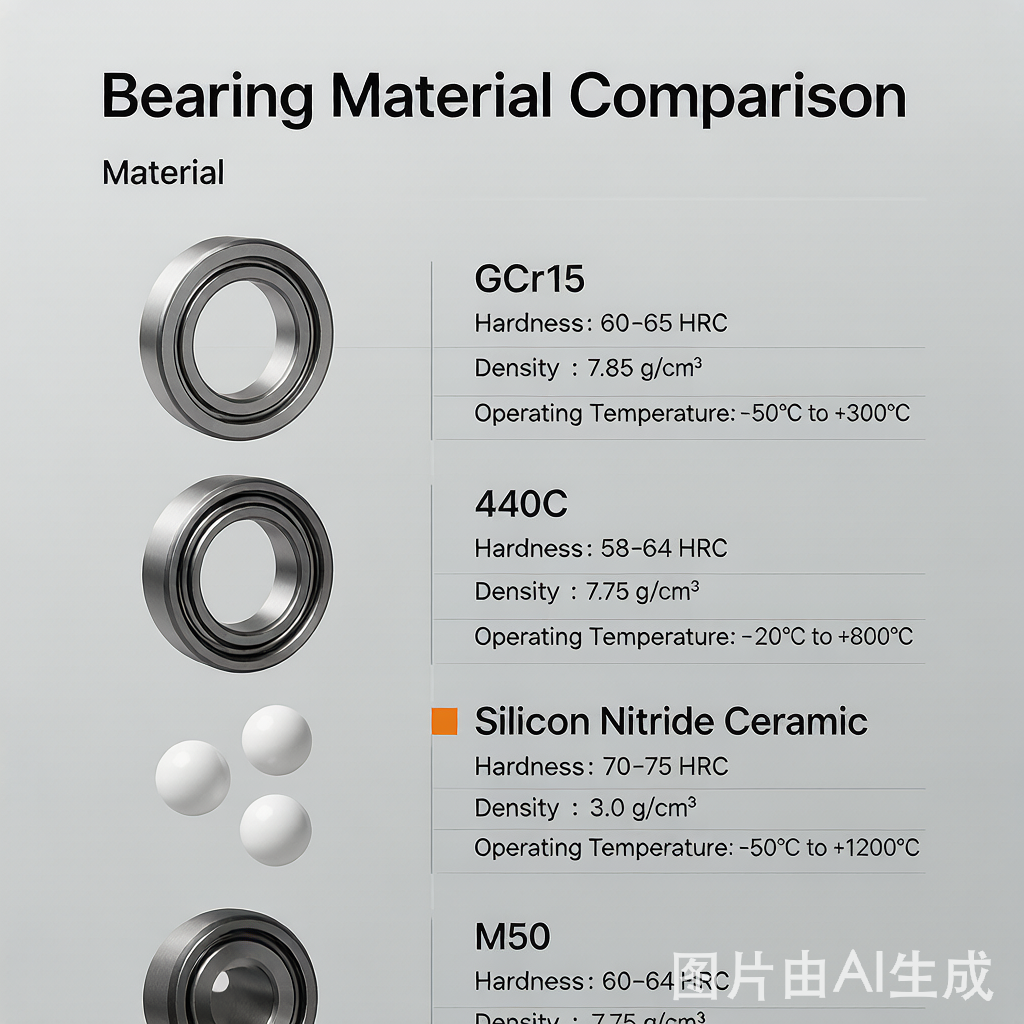
Material selection directly impacts corrosion resistance, temperature capability, and fatigue life. The most common bearing materials are:
| Material | Hardness (HRC) | Temp Limit | Corrosion Resistance | Best For |
|---|---|---|---|---|
| GCr15 (AISI 52100) | 58-64 | 120 C | Poor | General industrial, standard applications |
| 440C Stainless Steel | 58-60 | 150 C | Good | Food processing, medical, marine |
| Silicon Nitride (Si3N4) | 78 HV10 | 800 C | Excellent | High-speed spindles, vacuum, aerospace |
| Zirconia (ZrO2) | 70 HV10 | 400 C | Excellent | Chemical, semiconductor, non-magnetic |
| M50 Tool Steel | 60-65 | 315 C | Poor | Aircraft engines, high-temp applications |
Pro tip: If your application involves washdown environments, food contact, or outdoor exposure, stainless steel bearings are not optional — they are mandatory. The slight reduction in load capacity is worth avoiding corrosion-related failures.
Step 5: Select Precision Grade (ABEC / ISO)
Precision grade determines dimensional tolerance, running accuracy, and overall performance consistency. The ABEC scale (Annular Bearing Engineering Committee) is widely used in North America, while ISO P grades are the international standard.
| ABEC Grade | ISO Grade | Typical Application | Cost Multiplier |
|---|---|---|---|
| ABEC-1 | P0 | General industrial, conveyors, fans | 1x (baseline) |
| ABEC-3 | P6 | Electric motors, pumps, gearboxes | 1.5-2x |
| ABEC-5 | P5 | Machine tool spindles, precision instruments | 3-5x |
| ABEC-7 | P4 | High-speed spindles, aerospace gyroscopes | 8-12x |
| ABEC-9 | P2 | Ultra-precision instruments, optics | 20-30x |
Most industrial applications are well-served by ABEC-1 or ABEC-3. Higher grades are only necessary when RPM exceeds 10,000, vibration limits are tight, or the application requires sub-micron accuracy. Do not overspend on precision grade if your application does not require it.
Step 6: Verify Sealing and Lubrication
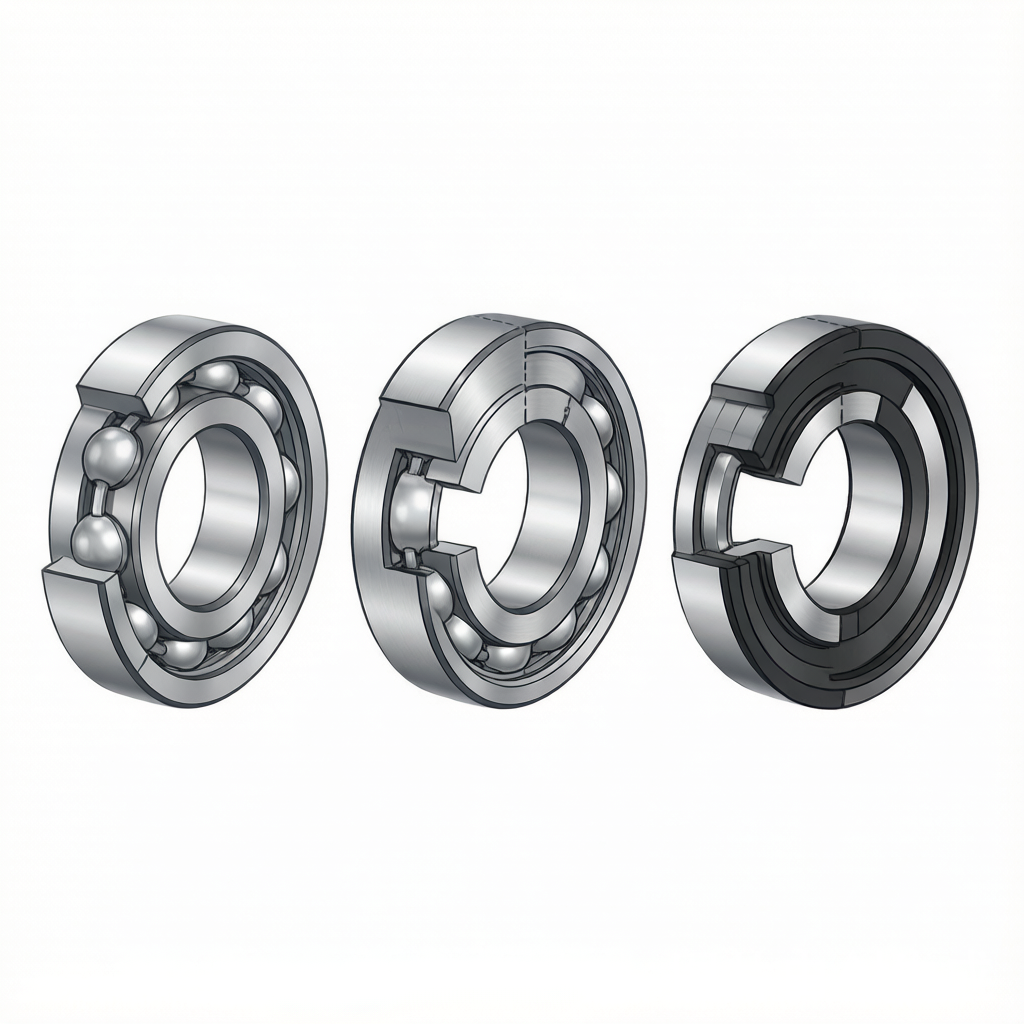
Even the best bearing will fail quickly without proper sealing and lubrication. The choice depends on operating environment:
Seal Types
- ZZ / 2Z (Metal Shield): Non-contact, low friction, good for clean environments, high-speed applications. Not waterproof. Typical speed: 70-80% of open bearing limit.
- 2RS / 2RSH (Rubber Seal): Contact seal, excellent dust and water protection. Slightly higher friction. Typical speed: 60-70% of open bearing limit. Best for outdoor, agricultural, and construction equipment.
- Open (No Seal): Highest speed capability, but requires external lubrication system. Used in oil-bath and oil-mist applications like gearboxes and machine tool spindles.
Lubrication Options
- Grease (Lithium-based): Standard for most applications. Pre-filled sealed bearings typically use about 25-35% fill.
- Grease (Polyurea): Higher temperature rating (up to 180 C). Common in electric motor bearings.
- Oil: Required for very high-speed applications and where heat must be carried away. Oil-bath, oil-mist, or oil-jet systems.
- Food-grade grease (H1): Required for food and beverage processing equipment. NSF H1 registered.
Step 7: Consider Mounting and Fit
Bearing fit — the interference or clearance between the bearing rings and the shaft/housing — is often overlooked but critically important. An incorrect fit can cause:
- Too tight: Internal clearance eliminated, overheating, early failure
- Too loose: Fretting corrosion, shaft damage, noise, inaccurate running
General fit recommendations:
| Rotating Ring | Shaft Fit | Housing Fit |
|---|---|---|
| Inner ring rotates (most common) | Tight (k5, m5, m6) | Loose (H7, G7) |
| Outer ring rotates (wheel hubs) | Loose (g6, h6) | Tight (N7, M7) |
Always consult the bearing manufacturer fit tables for your specific size and application type. The above is a starting point, not a final recommendation.
Bearing Selection Checklist
Use this checklist before finalizing your bearing specification:
- Load type confirmed: Radial, axial, or combined? Ratio known?
- Speed verified: RPM within bearing limiting speed with chosen seal and lubrication?
- Life calculated: L10 meets or exceeds required operating hours?
- Material selected: Correct for environment (corrosion, temperature, cleanliness)?
- Precision appropriate: ABEC/ISO grade matches performance needs without overspending?
- Sealing correct: Shield, seal, or open with external lubrication?
- Lubrication specified: Grease type, fill percentage, or oil system defined?
- Fit verified: Shaft and housing tolerances confirmed from manufacturer tables?
- Internal clearance: C3 for press fits or high temperature? CN (normal) for standard?
- Cage material: Steel, brass, or polyamide? Correct for temperature and speed?
Common Bearing Selection Mistakes
After 15+ years in the bearing industry, here are the mistakes we see most often:
- Copying the old bearing number without checking — The original designer may have selected the wrong bearing years ago. Always verify.
- Ignoring axial load — Many engineers underestimate axial forces. If in doubt, add 10-15% margin.
- Using the same bearing for all positions — Fixed-end and floating-end bearings often need different types or fits.
- Overlooking thermal expansion — Long shafts expand. Provide axial clearance or use cylindrical roller bearings with NU/N design at the floating end.
- Choosing by price only — A bearing that costs 30% less but fails in 6 months costs far more than a quality bearing lasting 5 years.
Interested in Custom Bearing Solutions?
If you are unsure about any aspect of bearing selection, or need a customized bearing for your specific application, our engineering team at Shandong Borette Bearing Technology Co., Ltd. is ready to help. We manufacture a complete range of deep groove ball bearings, tapered roller bearings, angular contact bearings, and custom bearing solutions. Contact us with your application details — load, speed, environment, and required life.