
Introduction
The deep groove ball bearing is the most widely used rolling bearing in the world — from electric motors to bicycle hubs, from washing machines to industrial gearboxes. But within the category, there are distinct types differentiated by sealing and shielding configuration. Choosing the right type is crucial: an open bearing in a dusty environment will fail within weeks; a sealed bearing in a high-speed spindle will overheat. This guide breaks down each type, its applications, and its limitations, so you can specify the right 6xxx-series bearing for your design.
Open Bearings (No Suffix or “Open”)
An open deep groove ball bearing has no seals or shields — the rolling elements are fully exposed. This is the most basic and versatile type.
- Advantages: Lowest friction (no seal drag), highest speed capability (up to the bearing’s limiting speed), can use oil or grease lubrication, visual inspection of the interior is possible
- Disadvantages: Zero contamination protection, lubricant can escape freely, requires a sealed housing or external sealing system
- Applications: Gearboxes (oil bath lubrication), high-speed spindles (oil mist), applications where the bearing is enclosed within an oil-sealed housing
ZZ / 2Z Shielded Bearings (Metal Shields)
ZZ (or 2Z) bearings have non-contact metal shields pressed into the outer ring on both sides. The shields form a narrow labyrinth gap (typically 0.1-0.3mm) with the inner ring shoulder.
- Advantages: Moderate dust protection, retains factory grease fill, lower friction than rubber seals (no contact), good speed capability (about 85% of open bearing limit), shields are removable for cleaning
- Disadvantages: No liquid/water protection (labyrinth gap allows moisture ingress), dust particles smaller than the gap can enter, factory grease is the only lubricant for life (shielded bearings are typically “greased for life”)
- Applications: Electric motors (clean environment), fans, power tools, home appliances. The most common configuration for general-purpose industrial bearings.
2RS / 2RS1 / DDU Rubber Sealed Bearings (Contact Seals)
2RS (or 2RS1, DDU, LLU — depending on manufacturer) bearings have synthetic rubber seals with a flexible lip that contacts the inner ring shoulder, creating a positive seal.
- Advantages: Excellent contamination exclusion (dust, water splash, light chemicals), excellent grease retention, sealed for life (no relubrication). The lip seal is spring-loaded against the inner ring, maintaining contact even with slight wear.
- Disadvantages: Higher friction from seal lip contact (increases torque by 20-50% vs open), lower speed capability due to frictional heating (about 60-70% of open bearing limit), seal material temperature limit (NBR: 100°C continuous, FKM: 200°C), factory grease fill only (cannot be re-greased through the seal)
- Applications: Conveyor rollers (dusty/dirty), agricultural machinery (mud, water), automotive wheel hubs (water spray), food processing (washdown), any outdoor or contaminated environment.
RS / RU Non-Contact Sealed Bearings
A less common variant — RS or RU bearings have a lip seal that forms a narrow labyrinth (non-contact) rather than contacting the inner ring. This provides better protection than ZZ shields but lower friction than 2RS contact seals.
- Applications: Low-torque applications with moderate contamination, small electric motors where friction is a concern but some protection is needed.
Comparison Table
| Feature | Open | ZZ (2Z) | 2RS (Contact Seal) | RU (Non-Contact) |
|---|---|---|---|---|
| Dust protection | None | Moderate | Excellent | Good |
| Water protection | None | None | Good (splash) | Minimal |
| Friction torque | Lowest | Low | Moderate-High | Low-Moderate |
| Speed capability | 100% of limit | ~85% of limit | ~60-70% of limit | ~80% of limit |
| Relubrication | Yes | No (lifetime) | No (lifetime) | No (lifetime) |
| Seal removal | N/A | Removable | Destructive | Removable |
| Cost premium | Baseline | +5-10% | +15-25% | +15-20% |
How to Choose: Decision Flow
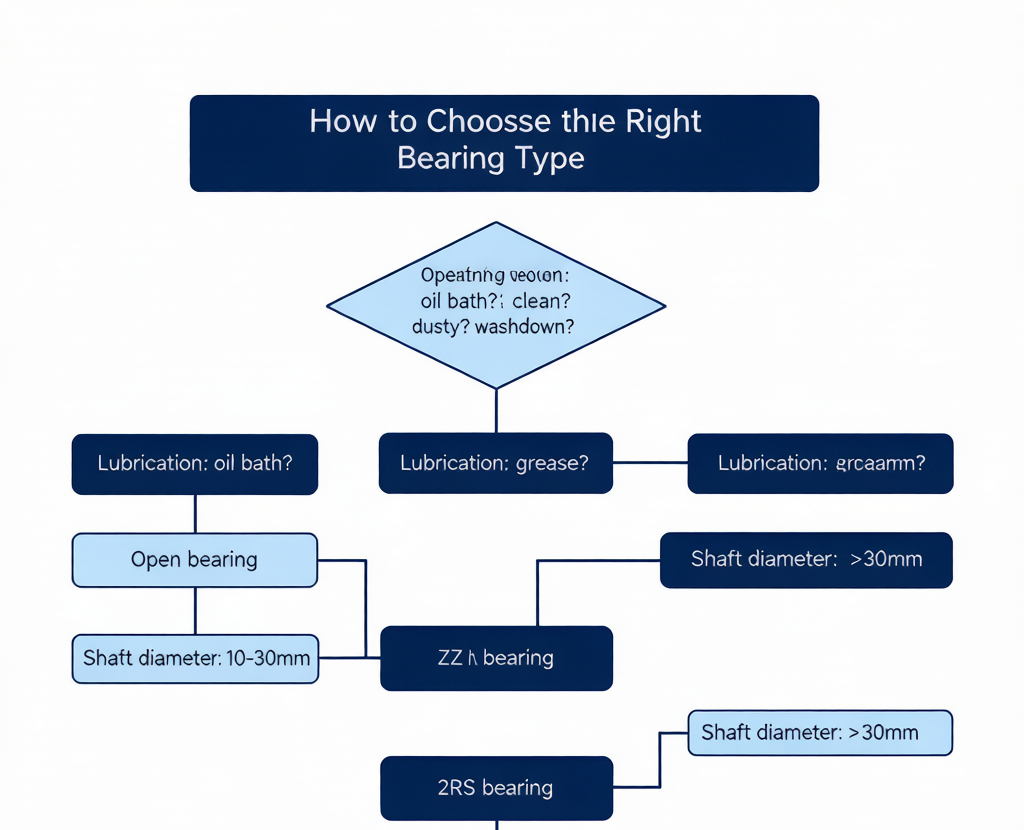
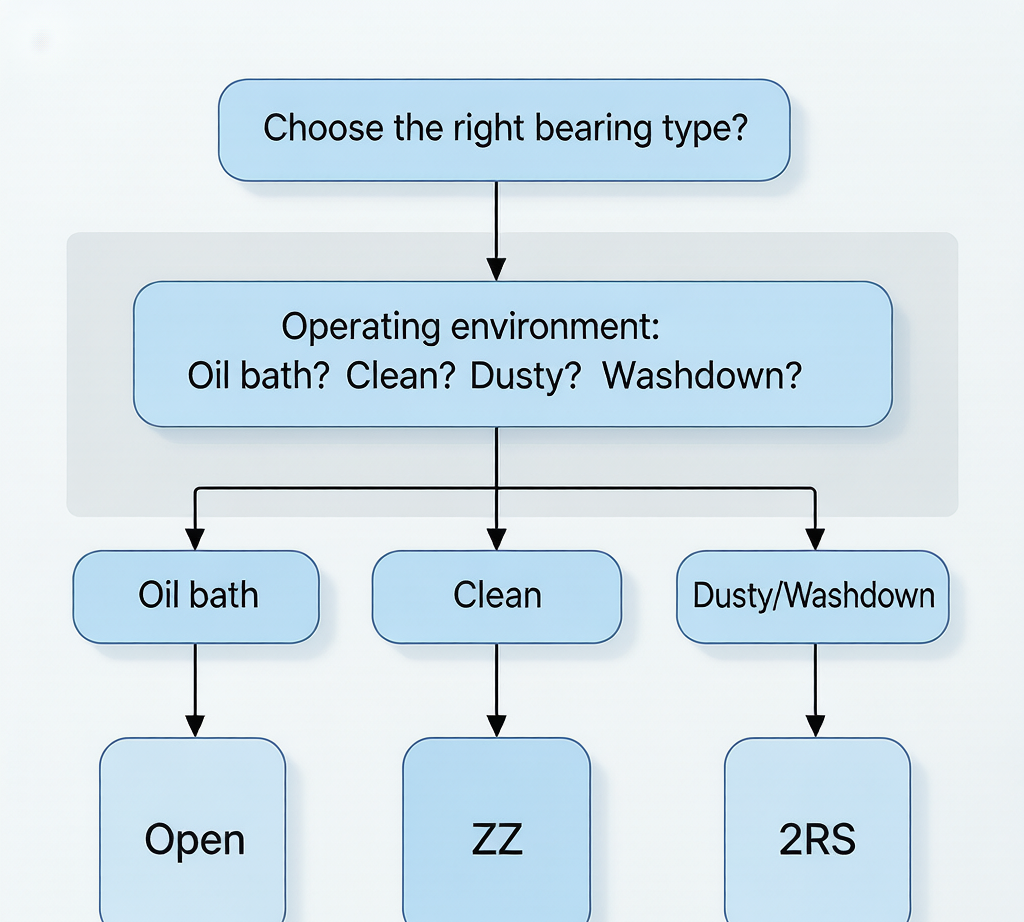
- Is the bearing running in an oil bath or oil mist system? → Use Open (the lubricant must reach the bearing interior)
- Is the environment clean (IP54+ enclosure) and speed above 80% of bearing limit? → Use ZZ shielded (low friction, moderate protection)
- Is the environment dusty, wet, or exposed to outdoor conditions? → Use 2RS sealed (full protection, accept speed limits)
- Does the application require relubrication? → Use Open in a re-greasable housing, or an RU non-contact sealed bearing
- Is the bearing exposed to washdown (food, chemical)? → Use 2RS with FKM (Viton) seals and stainless steel rings
Conclusion
The trade-off is simple: speed vs protection. Open bearings give you max speed but zero protection. ZZ shields give you good speed with moderate dust resistance. 2RS seals give you maximum protection at the cost of some speed. For most industrial applications, a 2RS sealed bearing is the safest default choice — it handles the widest range of environmental conditions. Boret supplies all four types in sizes from 6000 to 6410 and beyond, with NBR or FKM seal options.