
Introduction
Ceramic hybrid bearings — with steel rings and ceramic rolling elements — bridge the gap between standard all-steel bearings and exotic full-ceramic bearings. They offer higher speed capability, better electrical insulation, and longer life in marginal lubrication conditions. But not all ceramics are equal: silicon nitride (Si3N4) dominates the market, while zirconia (ZrO2) fills specific niche applications. This guide breaks down the material properties, applications, and cost trade-offs so you can choose correctly.
What Makes Ceramic Hybrid Bearings Different?
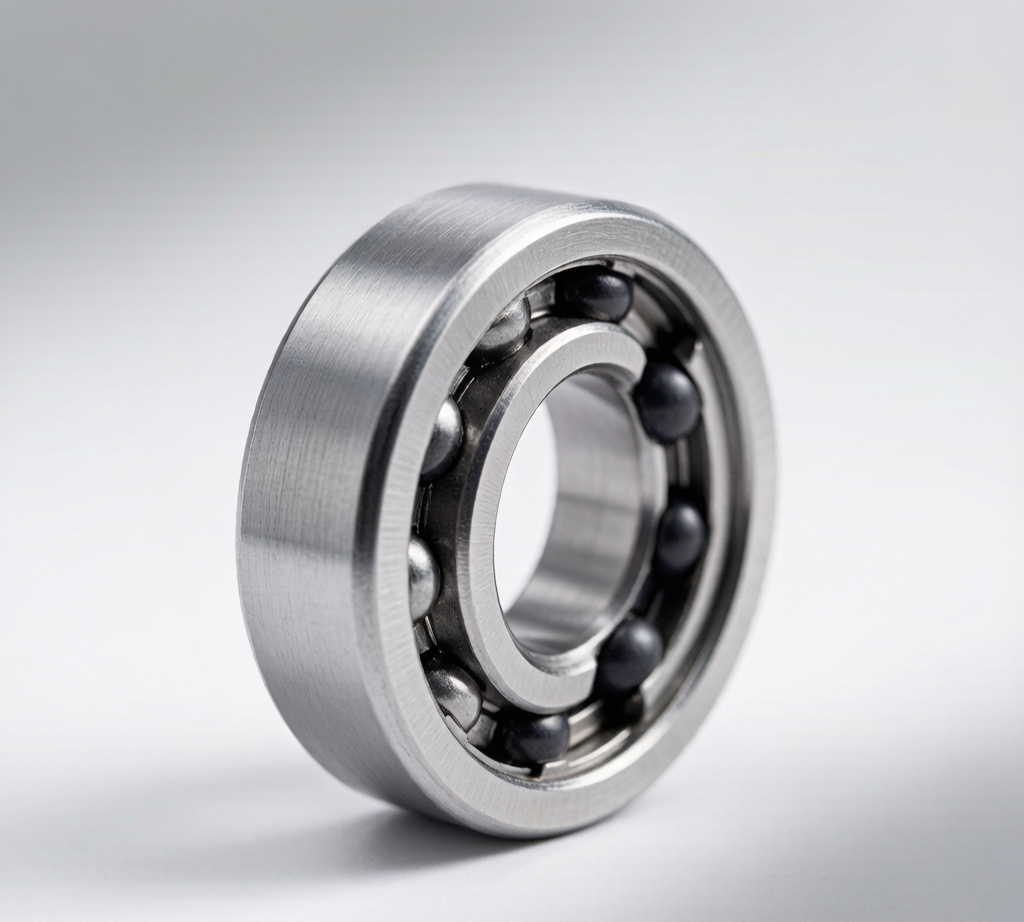
In a hybrid bearing, the inner and outer rings are standard bearing steel (typically 52100 or Cronidur 30 for corrosion-resistant versions), but the balls or rollers are made of ceramic. This gives you:
- 60% lower density — less centrifugal force at high speed, reducing contact stress on the outer raceway
- Higher hardness — ceramic balls don’t cold-weld to the steel rings during marginal lubrication events
- Electrical insulation — ceramic is an insulator, blocking shaft currents
- Lower coefficient of friction — about 30% less than steel-on-steel
- Higher stiffness — approximately 50% higher elastic modulus than steel, improving spindle rigidity
Si3N4 (Silicon Nitride): The Industry Standard
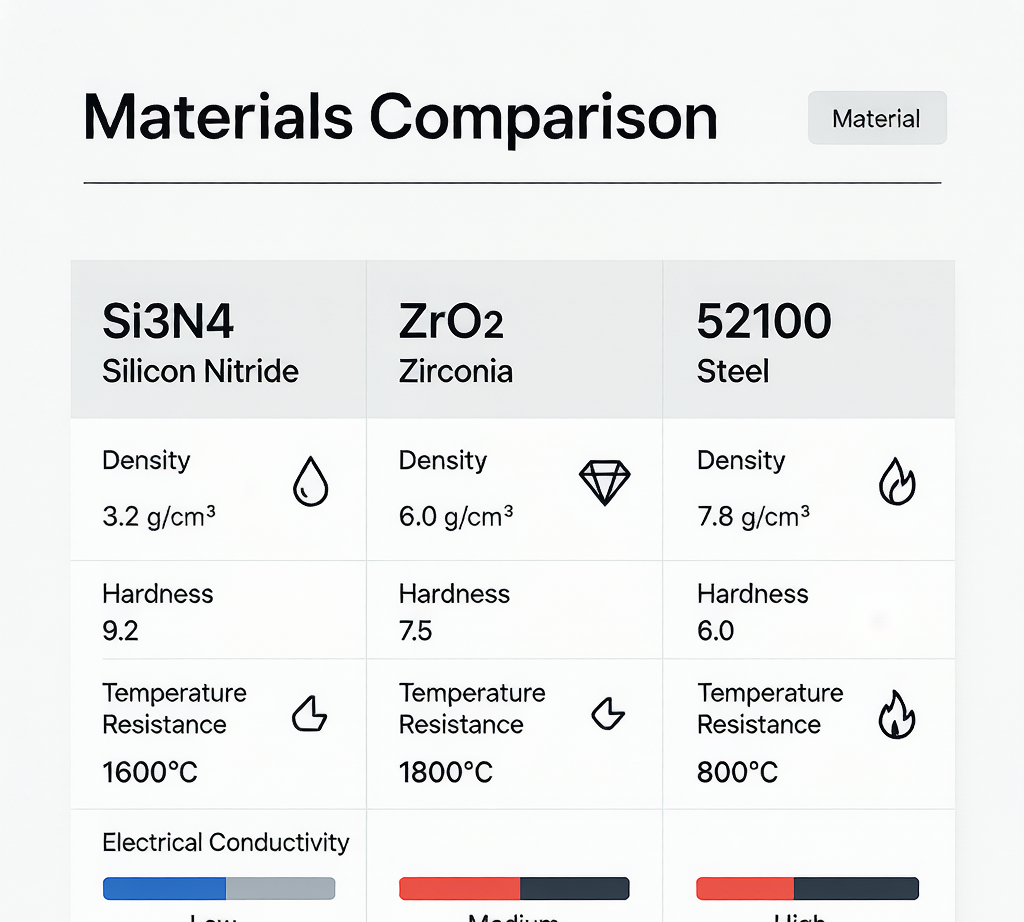
| Property | Si3N4 | 52100 Steel | Advantage |
|---|---|---|---|
| Density (g/cm³) | 3.2 | 7.8 | 60% lighter → less centrifugal force at high speed |
| Hardness (HV10) | 1,600 | 700 | 2x harder → better debris resistance |
| Elastic modulus (GPa) | 310 | 210 | 50% stiffer → greater spindle rigidity |
| Thermal expansion (10⁻⁶/K) | 3.2 | 12.5 | Lower expansion → stable preload at temperature |
| Max use temperature | 800°C | 150°C | Much higher thermal tolerance |
| Electrical resistivity | 10¹² Ω·cm | Conductive | Insulator → blocks shaft currents |
Best applications for Si3N4 hybrids: High-speed machine tool spindles (DN > 1,000,000), VFD-driven motors (blocks shaft currents), turbochargers (high speed + high temperature), aerospace APU bearings, dental drills, and semiconductor manufacturing (clean environment, no lubricant outgassing).
ZrO2 (Zirconia): The Niche Alternative
Zirconia ceramic balls offer one key advantage over Si3N4: higher fracture toughness. This makes ZrO2 better suited for applications with shock loading or impact. Key properties comparison:
- Fracture toughness: ZrO2 (8-12 MPa·m⁰·⁵) vs Si3N4 (5-7) — ZrO2 is 40-70% tougher
- Thermal conductivity: ZrO2 (2-3 W/m·K) vs Si3N4 (20-30) — ZrO2 is a better insulator
- Density: ZrO2 (6.0 g/cm³) vs Si3N4 (3.2) — ZrO2 is heavier, reducing the speed advantage
- Maximum speed: ZrO2 hybrids are limited to about DN 500,000 vs Si3N4 at DN 1,500,000+
Best applications for ZrO2: Medical devices (biocompatible — used in hip joint prostheses), chemical pumps, food processing (non-magnetic, corrosion-resistant), and applications with impact or shock loading where Si3N4 might fracture.
When Hybrid Bearings Are Overkill (and When They’re Necessary)
Hybrid bearings typically cost 3-10x more than equivalent all-steel bearings. They’re worth the premium when:
- DN > 800,000 — steel bearings hit physical limits from centrifugal ball loading
- VFD-driven motor > 30kW — shaft currents will destroy standard bearings within months
- Marginal lubrication — starved lubrication conditions where steel-on-steel would scuff
- Cleanroom / vacuum — reduced lubricant outgassing requirements
They’re probably NOT worth it for: standard industrial electric motors (C3 clearance steel bearings work fine), conveyor applications, agricultural equipment, and general machine building — unless electrical insulation or high speed is a specific requirement.
Conclusion
For 95% of hybrid bearing applications, Si3N4 is the correct and cost-effective choice. It delivers the speed, stiffness, and electrical insulation that justify the price premium. ZrO2 hybrids are reserved for applications where impact toughness, biocompatibility, or non-magnetic properties are required. Boret supplies both Si3N4 and ZrO2 hybrid bearings in standard ISO dimensions — contact us with your speed, load, and environmental requirements for a specific recommendation.