Introduction
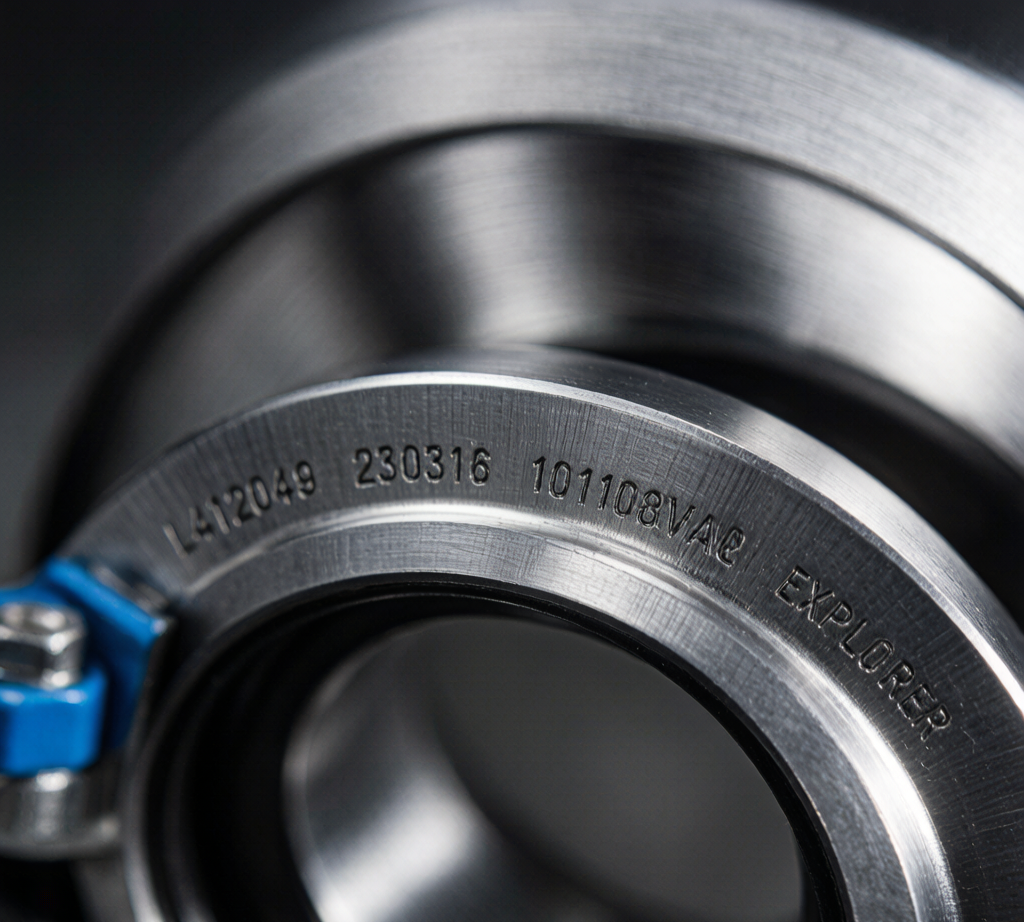
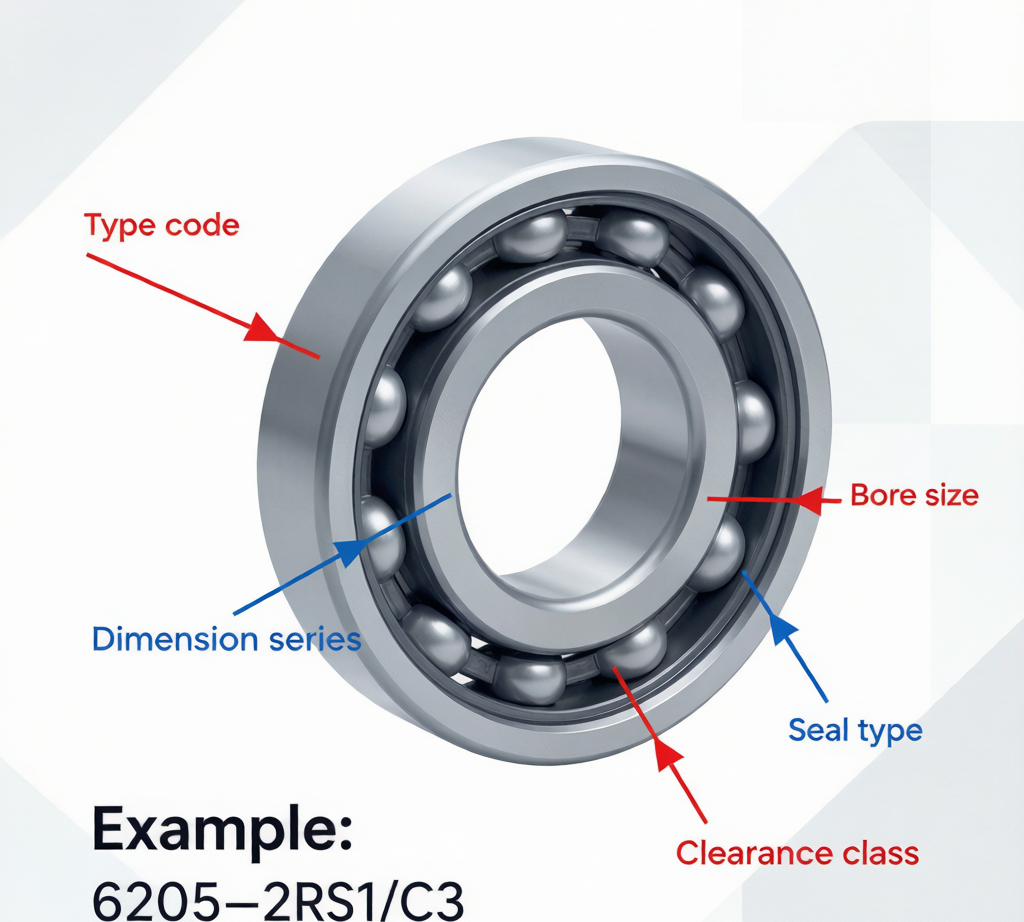
You have a bearing in your hand — it has numbers and letters etched on the ring, but no brand logo. How do you identify the manufacturer? More importantly, how do you verify it’s genuine and find an equivalent? This guide teaches you to decode bearing designation codes from the world’s major manufacturers: SKF, FAG, NSK, NTN, TIMKEN, KOYO, and others. By the end, you’ll be able to read a part number like 6205-2RS1/C3 and know exactly what it means and who likely made it.
Reading the Prefix: Manufacturer Identity Codes
The prefix is the first clue to manufacturer identity. While the basic dimension series (6205, 6308, etc.) is standardized under ISO 15, manufacturers add their own prefix systems:
- SKF: Uses suffixes for special features (e.g., 6205-2RS1/C3 where “2RS1” is SKF’s specific suffix for double rubber seal). SKF is one of the few that rarely uses prefixes on standard bearings.
- FAG (Schaeffler): Uses prefixes like “B” for spindle bearings (B7008), “NJ” for cylindrical rollers with inner ring ribs. FAG’s suffixes are distinct: “TVP” = glass-fiber reinforced polyamide cage, “M” = brass cage.
- NSK: Uses extensive prefix system — “HR” for high capacity, “TM” for special heat treatment, “BL” for max capacity types. NSK suffix “DDU” = double sealed (same function as SKF’s 2RS1).
- NTN: Similar to NSK — “LLU” suffix for contact seals, “LLB” for non-contact seals, “4T-” prefix for tapered roller bearings.
- TIMKEN: Entirly different system for tapered roller bearings — uses inch-based designations like “LM11949/LM11910” (cone/cup). For ball bearings acquired from Torrington/Fafnir, uses “K” prefix variants.
- KOYO: Uses “DG” prefix for automotive alternator bearings, “R” prefix for inch-dimension bearings. Koyo’s suffix “2RU” = double sealed.
Understanding the Basic Designation (the Middle Numbers)
The core of any bearing part number follows ISO 15 notation:
| Code Position | Meaning | Example (6308) |
|---|---|---|
| First digit(s) | Bearing type: 6=single-row deep groove ball, 7=angular contact, 22=self-aligning ball, NU=cylindrical roller, 30=spherical roller, 32=tapered roller | 6 = deep groove ball |
| Second digit | Width/diameter series: 0=extra light, 2=light, 3=medium, 4=heavy | 3 = medium series |
| Last two digits × 5 | Bore diameter in mm (for bores 20-480mm; special rules for smaller/larger) | 08×5 = 40mm bore |
Special bore rules: 00 = 10mm, 01 = 12mm, 02 = 15mm, 03 = 17mm. For bores below 10mm, the last digit is the actual bore (e.g., 625 = 5mm bore). For bores above 500mm, the bore size is written directly after a slash (e.g., 618/530).
Decoding Suffixes: Internal Clearance, Seals, Cage, Precision
This is where manufacturer identification becomes critical — each has its own suffix system:
| Feature | SKF | FAG | NSK | NTN |
|---|---|---|---|---|
| Double rubber seal | 2RS1 / 2RSH | 2RSR | DDU | LLU |
| Double metal shield | 2Z | 2ZR | ZZ | ZZ |
| C3 clearance | C3 | C3 | C3 | C3 |
| Polyamide cage | TN9 | TVP | T1X | T2 |
| Brass cage | M | M / MP | M | L1 |
| Steel cage | J | J / JP | W | J |
| P5 precision (ABEC-5) | P5 | P5 | P5 | P5 |
By reading the suffix style, you can often identify the manufacturer even if the logo is worn off: “2RS1” = SKF, “2RSR” = FAG, “DDU” = NSK, “LLU” = NTN.
Free Online Cross-Reference Tools
If you can read the part number but aren’t sure of the manufacturer, these cross-reference tools help identify equivalents:
- SKF Bearing Select — enter dimensions, find SKF equivalent
- NSK Bearing Finder — search by part number or dimensions
- NTN Bearing Finder — cross-reference competitor part numbers
- Boret Bearings Cross-Reference — our engineering team provides free cross-reference by email (send photo + dimensions)
When to Use Equivalents vs OEM
Using an equivalent (interchangeable) bearing is perfectly acceptable for most standard industrial applications — deep groove ball bearings, spherical roller bearings, tapered roller bearings are manufactured to ISO standards with interchangeable dimensions. However, stick with OEM for:
- Proprietary designs (specific internal geometry optimized for a particular machine)
- High-speed spindles with matched bearing sets
- Aerospace and medical applications with traceability requirements
- Warranty-sensitive equipment where a non-OEM part might void coverage
Conclusion
Reading a bearing number is a learnable skill. Focus on the suffix first (it’s the most brand-specific), then verify the basic dimensions (bore × 5 rule), and finally use the prefix for manufacturing line information. If you’re ever unsure about a bearing’s origin or authenticity, send a clear photo of the marking to Boret’s engineering team — we identify bearings daily and can usually confirm the manufacturer within minutes.
2>IntroductionYou have a bearing in your hand — it has numbers and letters etched on the ring, but no brand logo. How do you identify the manufacturer? More importantly, how do you verify it’s genuine and find an equivalent? This guide teaches you to decode bearing designation codes from the world’s major manufacturers: SKF, FAG, NSK, NTN, TIMKEN, KOYO, and others. By the end, you’ll be able to read a part number like 6205-2RS1/C3 and know exactly what it means and who likely made it.
Reading the Prefix: Manufacturer Identity Codes
The prefix is the first clue to manufacturer identity. While the basic dimension series (6205, 6308, etc.) is standardized under ISO 15, manufacturers add their own prefix systems:
- SKF: Uses suffixes for special features (e.g., 6205-2RS1/C3 where “2RS1” is SKF’s specific suffix for double rubber seal). SKF is one of the few that rarely uses prefixes on standard bearings.
- FAG (Schaeffler): Uses prefixes like “B” for spindle bearings (B7008), “NJ” for cylindrical rollers with inner ring ribs. FAG’s suffixes are distinct: “TVP” = glass-fiber reinforced polyamide cage, “M” = brass cage.
- NSK: Uses extensive prefix system — “HR” for high capacity, “TM” for special heat treatment, “BL” for max capacity types. NSK suffix “DDU” = double sealed (same function as SKF’s 2RS1).
- NTN: Similar to NSK — “LLU” suffix for contact seals, “LLB” for non-contact seals, “4T-” prefix for tapered roller bearings.
- TIMKEN: Entirly different system for tapered roller bearings — uses inch-based designations like “LM11949/LM11910” (cone/cup). For ball bearings acquired from Torrington/Fafnir, uses “K” prefix variants.
- KOYO: Uses “DG” prefix for automotive alternator bearings, “R” prefix for inch-dimension bearings. Koyo’s suffix “2RU” = double sealed.
Understanding the Basic Designation (the Middle Numbers)
The core of any bearing part number follows ISO 15 notation:
| Code Position | Meaning | Example (6308) |
|---|---|---|
| First digit(s) | Bearing type: 6=single-row deep groove ball, 7=angular contact, 22=self-aligning ball, NU=cylindrical roller, 30=spherical roller, 32=tapered roller | 6 = deep groove ball |
| Second digit | Width/diameter series: 0=extra light, 2=light, 3=medium, 4=heavy | 3 = medium series |
| Last two digits × 5 | Bore diameter in mm (for bores 20-480mm; special rules for smaller/larger) | 08×5 = 40mm bore |
Special bore rules: 00 = 10mm, 01 = 12mm, 02 = 15mm, 03 = 17mm. For bores below 10mm, the last digit is the actual bore (e.g., 625 = 5mm bore). For bores above 500mm, the bore size is written directly after a slash (e.g., 618/530).
Decoding Suffixes: Internal Clearance, Seals, Cage, Precision
This is where manufacturer identification becomes critical — each has its own suffix system:
| Feature | SKF | FAG | NSK | NTN |
|---|---|---|---|---|
| Double rubber seal | 2RS1 / 2RSH | 2RSR | DDU | LLU |
| Double metal shield | 2Z | 2ZR | ZZ | ZZ |
| C3 clearance | C3 | C3 | C3 | C3 |
| Polyamide cage | TN9 | TVP | T1X | T2 |
| Brass cage | M | M / MP | M | L1 |
| Steel cage | J | J / JP | W | J |
| P5 precision (ABEC-5) | P5 | P5 | P5 | P5 |
By reading the suffix style, you can often identify the manufacturer even if the logo is worn off: “2RS1” = SKF, “2RSR” = FAG, “DDU” = NSK, “LLU” = NTN.
Free Online Cross-Reference Tools
If you can read the part number but aren’t sure of the manufacturer, these cross-reference tools help identify equivalents:
- SKF Bearing Select — enter dimensions, find SKF equivalent
- NSK Bearing Finder — search by part number or dimensions
- NTN Bearing Finder — cross-reference competitor part numbers
- Boret Bearings Cross-Reference — our engineering team provides free cross-reference by email (send photo + dimensions)
When to Use Equivalents vs OEM
Using an equivalent (interchangeable) bearing is perfectly acceptable for most standard industrial applications — deep groove ball bearings, spherical roller bearings, tapered roller bearings are manufactured to ISO standards with interchangeable dimensions. However, stick with OEM for:
- Proprietary designs (specific internal geometry optimized for a particular machine)
- High-speed spindles with matched bearing sets
- Aerospace and medical applications with traceability requirements
- Warranty-sensitive equipment where a non-OEM part might void coverage
Conclusion
Reading a bearing number is a learnable skill. Focus on the suffix first (it’s the most brand-specific), then verify the basic dimensions (bore × 5 rule), and finally use the prefix for manufacturing line information. If you’re ever unsure about a bearing’s origin or authenticity, send a clear photo of the marking to Boret’s engineering team — we identify bearings daily and can usually confirm the manufacturer within minutes.