
Introduction
Under-lubricated bearings run dry and fail. Over-lubricated bearings overheat, blow seals, and contaminate the product. Getting the interval and quantity right is the single highest-impact maintenance practice for extending bearing service life. This guide provides the formulas, tables, and rules of thumb that maintenance teams and reliability engineers use to build lubrication schedules that work.
Why Lubrication Intervals Matter
Bearing grease doesn’t last forever. Over time, the base oil separates from the thickener (bleeding), oxidation thickens the grease, and contaminants accumulate. The function of relubrication is to:
- Purge old, degraded grease out of the bearing housing
- Replenish the oil film in the rolling contact zone
- Flush out contaminants that have entered through seals
- Restore corrosion protection on raceway surfaces
Relubrication Interval Formula
The industry-standard formula for calculating relubrication intervals comes from bearing manufacturers’ engineering data:
t = K × [(14,000,000 / (n × d⁰·⁵)) – 4d]
Where:
- t = relubrication interval (hours)
- K = product factor (0.5 for spherical roller bearings, 1.0 for ball and cylindrical roller bearings)
- n = operating speed (RPM)
- d = bearing bore diameter (mm)
Example: A 6208 deep groove ball bearing (40mm bore) running at 3,600 RPM: t = 1.0 × [(14,000,000 / (3,600 × 6.32)) – 160] = 1.0 × [615 – 160] = 455 hours (≈19 days of continuous operation).
Adjust this base interval for your conditions: reduce by 50% for high temperature (>70°C), 30% for heavy contamination, or 20% if the bearing is vertically mounted.
Re-Greasing Quantity: How Much Is Enough?
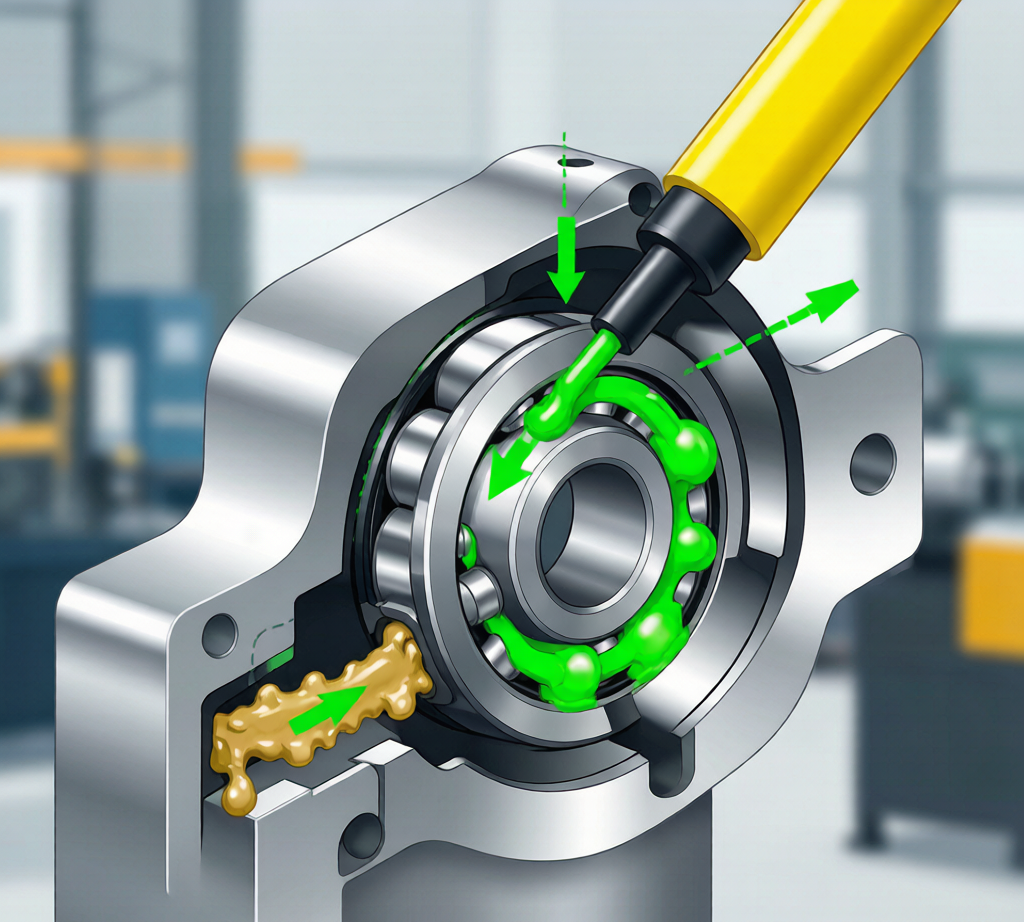
The correct quantity for relubrication is:
G = 0.005 × D × B
Where G is grease quantity in grams, D is the bearing OD in mm, and B is the bearing width in mm. For a sealed housing: G = 0.002 × D × B.
More practically, for open bearings in a plumber block housing, fill the housing 30-50% full with grease. Never fill beyond 50% — the bearing needs space to churn the grease without excessive friction. A common field technique is to pump grease while the shaft is rotating until you see fresh grease emerging from the seals, then stop.
Grease Selection: NLGI Grades and Base Oil Viscosity
| NLGI Grade | Consistency | Typical Application |
|---|---|---|
| 000 | Fluid (like honey) | Centralized lubrication systems, gearboxes |
| 00 | Semi-fluid | Enclosed gear drives |
| 0 | Very soft | Centralized systems, cold climate |
| 1 | Soft | Centralized systems, low temperature |
| 2 | Medium (most common) | Standard industrial bearings, electric motors |
| 3 | Firm | Large bearings, vertical shaft, high temperature |
For base oil viscosity, choose a viscosity ratio κ = ν / ν₁ ≥ 1 (where ν is actual operating viscosity, ν₁ is the rated viscosity for the bearing size and speed). For high temperature, high load, or low speed, aim for κ ≥ 2-4.
Signs of Lubrication Problems
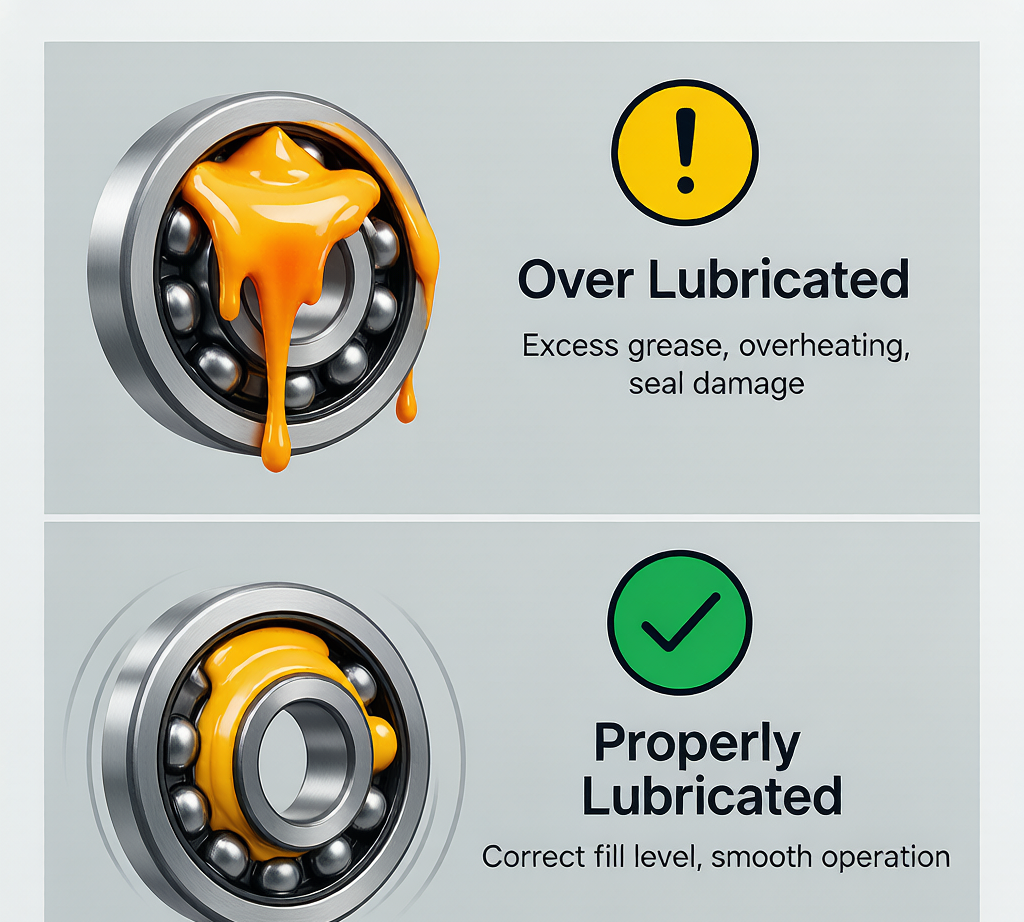
Over-Lubrication
- Bearing runs hot (temperature rise >40°C above ambient)
- Grease leaking excessively from seals — compromised sealing integrity
- Motor current draw increases (higher churning friction)
- In food/pharma: product contamination from grease purge
Under-Lubrication
- Metallic noise — high-frequency ringing or grinding
- Vibration increases (monitor trend over weeks)
- Discoloration of raceway (blue/brown from heat)
- Grease appears dry, crusty, or blackened inside the bearing
- Visible metal particles in the spent grease
Maintenance Schedule Template
For a typical industrial plant, here’s a starting point for re-greasing schedules:
| Bearing Type | Operating Condition | Suggested Interval |
|---|---|---|
| Electric motor (IEC 63-160) | Clean, <70°C, 1,500-3,600 RPM | Every 2,000-4,000 hours |
| Pump bearing | Clean, <60°C, 1,500-3,000 RPM | Every 1,500-3,000 hours |
| Conveyor pulley | Moderate dust, <60°C, low speed | Every 500-1,000 hours |
| Fan bearing | Clean to moderate, <80°C | Every 1,500-2,500 hours |
| Vibrating screen | Heavy dust, shock loads | Every 8-24 hours (automatic lubricator recommended) |
Conclusion
A well-documented lubrication program — with calculated intervals, correct grease quantity, and condition-based adjustments — is the most cost-effective way to maximize bearing service life. When implementing a new lubrication schedule, start with the calculated interval, then adjust shorter or longer based on grease condition at each relubrication check. For assistance selecting the right grease and interval for your specific application, contact Boret’s technical support team.